
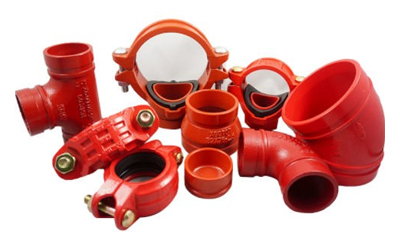
In modern fire suppression systems, the reliability and speed of installation are critical. Fire protection grooved pipe fittings have become the industry standard for joining pipes in sprinkler systems, standpipes, and hydrant networks. Unlike traditional threading or welding, these fittings utilize a mechanical gap-and-seal method that ensures a leak-proof connection under high pressure.
What are Fire Protection Grooved Pipe Fittings?
Fire protection grooved pipe fittings are heavy-duty components—usually made of ductile iron—designed to connect piping sections by seating into a groove cut or rolled around the end of the pipe. A resilient elastomeric gasket is compressed by the fitting housing to create a triple-seal effect.
Key Components:
- Housing: Typically ductile iron (ASTM A536), which provides structural strength.
- Gasket: Usually EPDM, designed to withstand the chemical treatments in fire water.
- Bolts & Nuts: Heat-treated carbon steel for high torque and vibration resistance.
Core Features & Benefits
The adoption of fire protection grooved pipe fittings offers several technical advantages over traditional methods:
- Speed of Installation: Grooved systems can be installed up to 3x faster than welded or threaded systems, significantly reducing labor costs.
- Vibration Dampening: The mechanical joint naturally absorbs noise and vibration, which is vital for high-pressure pump rooms.
- Flexibility & Alignment: Available in “Flexible” types that allow for thermal expansion/contraction and “Rigid” types for standard piping runs.
- Maintenance Friendly: Joints can be easily disassembled for system inspection or modifications without cutting the pipe.
Common Types and Their Applications
Different configurations of fire protection grooved pipe fittings are used depending on the layout of the fire protection network.
| Fitting Type | Primary Function | Common Application |
| Rigid Coupling | Joins two pipes with zero movement. | Main vertical risers and straight horizontal runs. |
| Flexible Coupling | Allows for angular deflection and expansion. | Areas prone to seismic activity or thermal shifts. |
| Grooved Elbow (90°/45°) | Changes the direction of the water flow. | Navigating corners in building structures. |
| Grooved Tee | Splits a single flow into two directions. | Connecting branch lines to the main water supply. |
| Mechanical Tee | Creates a branch outlet without cutting the main pipe. | Adding sprinkler heads to an existing line. |
| Grooved Reducer | Connects pipes of different diameters. | Transitioning from main supply lines to smaller branch lines. |
Essential Uses in Fire Protection Systems
- Automatic Sprinkler Systems: Used extensively in wet and dry pipe systems to connect the network of sprinkler heads throughout a building.
- Fire Standpipe Systems: The primary vertical pipes in high-rise buildings that provide hose connections for firefighters.
- Pump Room Piping: Managing the high-pressure output from fire pumps to the rest of the facility.
- Hydrant Systems: Connecting underground water mains to outdoor fire hydrants.
Comparison: Grooved vs. Traditional Methods
| Feature | Grooved Fittings | Welding | Threading |
| Hot Work Permit | Not Required | Required | Not Required |
| Skill Level | Moderate | High (Certified Welder) | Moderate |
| Safety | High (No open flame) | Lower (Fire hazard) | High |
| Seismic Resistance | Excellent | Average | Poor |