
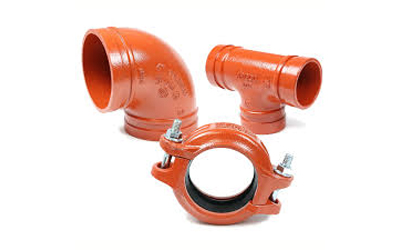
For engineers, contractors, and maintenance professionals, joining galvanized steel pipes presents a unique set of challenges. Traditional threading requires heavy machinery and removes the protective zinc coating at the joints, while welding is often impractical due to toxic fumes and fire hazards.
This is where compression fittings become a critical mechanical solution. In this technical deep dive, we will analyze the internal mechanics, material science, and performance standards of compression fittings—specifically focusing on high-quality Grooved Coupling options from Jianzhi Fittings—to understand how they create a leak-proof seal on galvanized surfaces without threading.
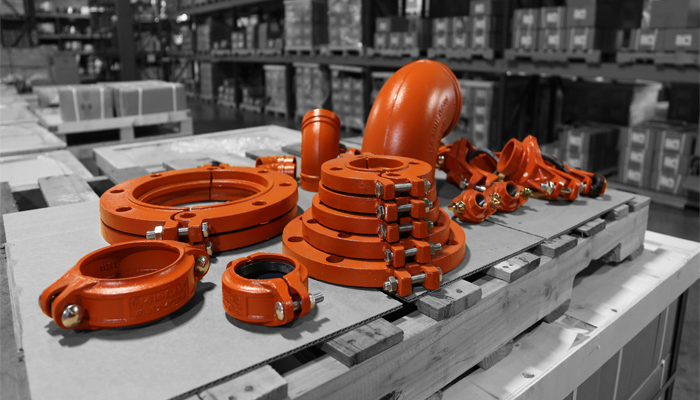
1. The Mechanical Anatomy of a Compression Fitting
A compression fitting does not rely on chemical bonds or interlocking threads on the pipe itself. Instead, it creates a seal through radial pressure. A standard fitting consists of three primary components:
A. The Fitting Body
Usually made of malleable cast iron, the body features a hollow center where the galvanized pipe is inserted. The interior is precision-machined to house the sealing ring and provide a “stop” for the pipe.
B. The Compression Ring (Olive or Ferrule)
This is the heart of the fitting. In galvanized pipe applications, this ring is often made of a durable elastomer (like NBR) or a soft metal. When pressure is applied, this ring deforms to fill the microscopic irregularities on the galvanized pipe’s surface.
C. The Compression Nut
As the nut is tightened onto the threaded exterior of the fitting body, it pushes the compression ring into the wedge-shaped seat. This mechanical action converts longitudinal force (tightening the nut) into radial force (squeezing the ring around the pipe).
2. The Physics of the Seal: Why It Works on Galvanized Surfaces
Galvanized steel pipe is coated with a layer of zinc to prevent corrosion. However, this coating creates a slightly uneven surface texture compared to smooth copper or stainless steel. A high-quality compression fitting overcomes this through two principles:
Friction and Compression
As the nut tightens, the internal ring is compressed until it “bites” or friction-locks onto the pipe. For galvanized pipes, the ring must be soft enough to conform to the zinc coating but rigid enough to maintain a seal under internal pressure.
Maintaining Coating Integrity
One of the primary technical advantages of using Jianzhi galvanized compression fittings is that they do not require the removal of the zinc layer. Threading strips the pipe down to the raw steel, creating a “weak point” for rust. Compression fittings preserve the galvanized envelope, significantly extending the lifespan of the piping system.
3. Material Matters: Why Malleable Iron is the Industry Standard
While plastic or brass compression fittings exist, they are often insufficient for the high-pressure and high-temperature demands of industrial galvanized systems.
Malleable iron is preferred for several reasons:
- Ductility: Unlike standard cast iron, malleable iron can withstand the mechanical stress of the compression nut without cracking.
- Thermal Expansion: It has a thermal expansion coefficient similar to the galvanized steel pipe it connects, preventing leaks during temperature fluctuations.
- Corrosion Resistance: When hot-dip galvanized, malleable iron fittings provide a unified, rust-resistant system that matches the durability of the pipe.
4. Performance Standards and Pressure Ratings
In industrial and firefighting applications, “good enough” is not an option. Technical specifications must meet international benchmarks.
| Feature | Technical Specification (Standard) |
| Material Grade | Black or Galvanized Malleable Cast Iron (BS EN 1562) |
| Pressure Rating | Typically PN16 or PN25 (depending on size) |
| Working Temperature | -20°C to 120°C (with appropriate EPDM/NBR seals) |
| Standard Compliance | ISO 49 / EN 10242 / UL & FM (for Fire Systems) |
For critical infrastructure, utilizing UL/FM certified fittings from Jianzhi ensures that the mechanical joint can withstand sudden pressure surges common in fire sprinkler systems.
5. Critical Installation Factors for Professional Results
To achieve a 100% leak-proof “Deep Dive” seal, certain technical protocols must be followed:
- Pipe End Preparation: The galvanized pipe must be cut square. Burrs on the outside of the pipe can slice the compression ring during insertion, leading to “ghost leaks” later.
- Insertion Depth: The pipe must be pushed past the sealing ring until it hits the internal shoulder of the fitting.
- Torque Control: Over-tightening can deform the malleable iron nut or crush the sealing ring, while under-tightening allows the pipe to blow out under pressure. Professionals often use a “flats-from-finger-tight” rule of thumb (typically 1 to 1.5 turns).
6. Applications: When to Specify Compression Over Threading
While threaded connections are traditional, compression fittings are technically superior in the following scenarios:
- Repair of Existing Lines: When a section of galvanized pipe is rusted out, cutting and sliding in a compression coupling is faster and safer than trying to thread a pipe in situ.
- Confined Spaces: Threading machines require significant clearance. Compression fittings only require a wrench.
- Transitioning Materials: They are excellent for joining galvanized steel to other materials without complex adapters.
Conclusion: Engineering Reliability into Every Joint
Compression fittings are not just a “quick fix”; they are a sophisticated mechanical joining method. By leveraging the ductility of malleable iron and the science of radial compression, brands like Jianzhi Fittings provide a solution that maintains the integrity of the galvanized coating while ensuring a high-pressure seal.
When your project demands speed, durability, and corrosion resistance, understanding the technical mechanics of the galvanized compression fitting is the first step toward a superior piping system.
Ready to source high-performance fittings for your next project?
Browse the Jianzhi Product Catalog or Request a Quote for bulk industrial orders.