
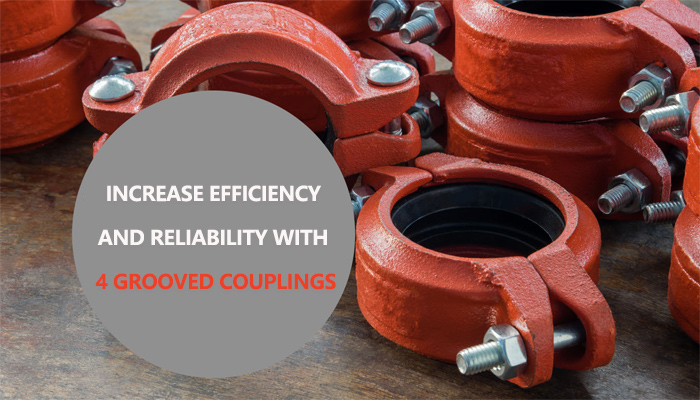
In modern fire protection, HVAC, and industrial piping networks, grooved pipe fittings and couplings have largely replaced traditional welding and threading due to their faster installation speed, vibration absorption, and ease of maintenance.
However, the integrity of any grooved piping system depends entirely on how the groove is formed on the pipe end. Engineers and contractors must choose between two distinct methods: Roll Grooving and Cut Grooving.
While both produce a circumferential groove designed to house a mechanical coupling key, they interact with the steel pipe in fundamentally different ways—directly impacting minimum wall thickness requirements and maximum allowable working pressure (MAWP).
1. The Core Mechanical Difference: Displacement vs. Removal
Understanding how each grooving method alters the steel structure is critical before specifying pipe schedules for a project.
What is Roll Grooving?
Roll grooving is a cold-forming process. A grooving roller presses into the exterior surface of the rotating pipe while an internal support roller backs up the inner wall.
- Metal Behavior: No metal is removed. Instead, the steel is cold-worked and displaced radially inward, creating a slight internal flare (or “upset”) inside the pipe bore.
- Best For: Light-wall and standard-wall steel pipes (Schedule 10 through Schedule 40).
What is Cut Grooving?
Cut grooving is a machining process similar to lathe turning. A sharp cutting tool physically carves a rectangular channel into the outer circumference of the pipe end.
- Metal Behavior: Metal is permanently removed from the pipe wall. The internal diameter remains completely smooth with zero inward protrusion.
- Best For: Heavy-wall steel pipes (Schedule 40, Schedule 80, and higher), as well as lined or coated pipes (such as cement-mortar lined or plastic-lined pipes) where cold-forming would crack the internal lining.
2. Impact on Pipe Wall Thickness (Schedule 10 vs. Schedule 40)
Because cut grooving removes steel while roll grooving displaces it, each method dictates strict minimum wall thickness thresholds under AWWA C606 and UL/FM standards.
Why You Cannot Cut Groove Schedule 10 Pipe
On a thin-walled Schedule 10 pipe (for example, 4-inch Schedule 10 has a nominal wall thickness of just 0.120 inches / 3.05 mm), a standard cut groove requires removing roughly 0.062 inches (1.57 mm) of steel. That removes over 50% of the pipe wall, leaving insufficient steel to withstand internal fluid pressure or external mechanical bending loads.
Therefore, Schedule 10 steel pipes must exclusively be roll grooved.
Minimum Wall Thickness Reference (Standard Carbon Steel Pipe)
| Nominal Pipe Size (NPS) | Roll Grooving Min. Wall Thickness | Cut Grooving Min. Wall Thickness |
| 1″ – 2″ (DN25 – DN50) | 0.065″ (1.65 mm) | 0.133″ (3.38 mm) – Sch 40 |
| 2-1/2″ – 4″ (DN65 – DN100) | 0.083″ (2.11 mm) | 0.188″ (4.78 mm) – Sch 40 |
| 6″ (DN150) | 0.109″ (2.77 mm) | 0.219″ (5.56 mm) – Sch 40 |
| 8″ (DN200) | 0.109″ (2.77 mm) | 0.238″ (6.05 mm) – Sch 40 |
| 10″ – 12″ (DN250 – DN300) | 0.134″ (3.40 mm) | 0.250″ (6.35 mm) – Std Wall |
(Note: Always verify exact dimensional tolerances against the coupling manufacturer’s technical datasheet prior to fabrication.)
3. Impact on Pressure Ratings (MAWP)
A common misconception among buyers is that cut grooving always yields higher pressure ratings. In reality, pressure ratings are determined by the combination of the pipe schedule, the grooving method, and the coupling housing design.
Pressure Performance on Schedule 40 Pipe
When applied to standard Schedule 40 steel pipe, roll grooving actually preserves higher structural integrity at the groove root because cold-working compresses the grain structure of the steel rather than severing it.
- On 2″ to 6″ Schedule 40 pipe, high-pressure rigid grooved couplings paired with roll-grooved ends routinely achieve working pressures up to 750 psi – 1,000 psi (51.7 – 68.9 bar).
- The same Schedule 40 pipe with a cut groove typically carries a slightly lower pressure rating (often 500 psi – 750 psi) because the net remaining wall thickness beneath the groove is thinner.
Pressure Performance on Schedule 10 Pipe
Because Schedule 10 pipe has a thinner base wall, a roll-grooved Schedule 10 joint naturally carries a lower maximum working pressure than Schedule 40—typically rated at 300 psi (20.7 bar) for UL/FM fire protection systems. While lower than Schedule 40, 300 psi easily exceeds the standard 175 psi working pressure required for most commercial fire sprinkler networks, allowing contractors to save significantly on pipe material weight and cost.
4. Side-by-Side Comparison: Roll vs. Cut Grooving
| Evaluation Factor | Roll Grooving | Cut Grooving |
| Material Removal | None (cold-formed displacement) | Removes steel chips from outer wall |
| Pipe Schedule Compatibility | Light to Standard Wall (Sch 10 – Sch 40) | Standard to Heavy Wall (Sch 40 – Sch 80+) |
| Internal Bore Profile | Slight inward flare at the groove | Completely flush, uninterrupted bore |
| Lined / Coated Pipes | Not recommended (damages internal lining) | Ideal (preserves cement/epoxy linings) |
| Field Fabrication Speed | Fast, clean, zero cutting fluid or chips | Slower, requires cutting oil and deburring |
| Corrosion Risk at Groove | Lower (zinc coating stretches with steel) | Higher on galvanized pipe (exposes bare steel) |
5. Practical Selection Guidelines for Engineers & Contractors
- For Commercial Fire Sprinkler Systems (UL/FM): Choose Roll Grooving on Schedule 10 or Schedule 40 black/galvanized pipe. It preserves the galvanized zinc layer at the groove root and delivers fast on-site fabrication without metal shavings.
- For Lined Water Mains & Slurry Lines: Choose Cut Grooving on Schedule 40 or Schedule 80 pipe. Avoiding inward pipe deformation prevents cracking of internal cement-mortar or rubber linings, while the flush bore prevents turbulence and sediment buildup.
- For High-Pressure Industrial Process Piping: Use Schedule 40 or Schedule 80 pipe paired with heavy-duty ductile iron grooved fittings. Verify whether roll or cut grooving yields the highest pressure rating for your specific coupling model.
Source Certified Grooved Fittings & Couplings from Jianzhi
Even the most precise pipe groove will fail if paired with poorly cast couplings or sub-standard gaskets. Jianzhi manufactures a complete line of UL Listed and FM Approved ductile iron grooved couplings, elbows, tees, reducers, and mechanical tees engineered to meet strict AWWA C606 and ISO 6182 dimensional tolerances.
- Planning an upcoming fire protection or HVAC project? Contact our engineering team for factory-direct wholesale quotes and technical support.