
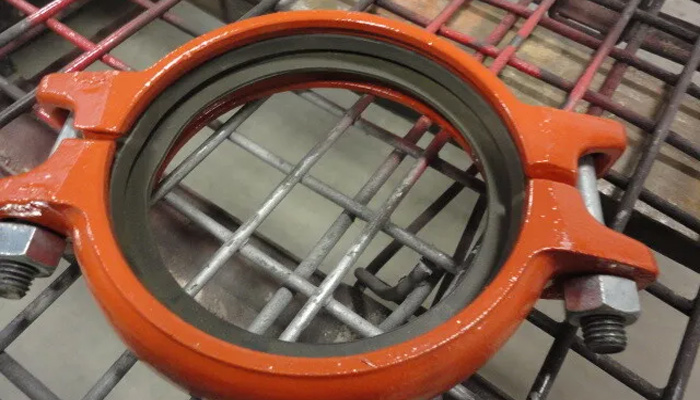
HEBEI, CHINA — In commercial HVAC, high-rise fire sprinkler networks, municipal water conveyance, and industrial fluid processing, grooved mechanical piping systems have largely replaced traditional welded and flanged connections. By eliminating on-site open flames, reducing labor hours, and accommodating system stress, grooved couplings have become the global standard for mechanical engineering contractors.
However, a fundamental decision during the system design phase is choosing between Rigid Grooved Couplings and Flexible Grooved Couplings.
While both utilize mechanical housings made of high-strength ductile iron (such as ASTM A536 Grade 65-45-12) and elastomeric gaskets (EPDM or NBR) to create a pressure-tight seal, their internal key-and-groove geometries serve opposite mechanical functions.
Below is an engineering overview from the technical team at Jianzhi Pipe Fittings detailing the mechanical mechanics, operational differences, and strategic selection criteria for both coupling types.
1. Understanding Rigid Grooved Couplings
A rigid grooved coupling is engineered to lock pipe ends tightly together, creating a stationary joint that mimics the structural rigidity of a welded or flanged connection.
Key Mechanical Design:
- Angle-Bolt Pad Mechanism: Rigid couplings typically feature cross-ribbed housing segments and angled bolt pads. As the bolts are torqued down, the housings slide in opposing directions, clamping the coupling keys firmly against the base of the pipe grooves.
- Zero Linear or Angular Movement: This positive mechanical grip prevents linear expansion, contraction, deflection, or rotation at the joint.
Primary Applications:
- Long vertical riser pipes in multi-story buildings where line straightness and column support are critical.
- Mechanical rooms, valve headers, and fire pump rooms where piping alignment must remain rigid around equipment.
- Long, straight horizontal runs suspended from overhead trapeze hangers.
2. Understanding Flexible Grooved Couplings
A flexible grooved coupling is intentionally designed to allow controlled movement at the pipe joint without compromising the pressure seal.
Key Mechanical Design:
- Narrower Key-to-Groove Clearance: The coupling keys fit into the pipe grooves with precise mechanical clearance. The keys engage the groove walls to prevent pipe separation under pressure, but allow the pipe ends to move within designed tolerances.
- Multi-Directional Joint Movement: Provides three distinct types of movement:
- Axial Movement: Linear expansion and thermal contraction along the pipe axis.
- Angular Deflection: Controlled angular bending to navigate subtle alignment shifts or structural settling.
- Rotational Movement: Torsional twisting flexibility under dynamic loads.
Primary Applications:
- Thermal expansion loops in commercial HVAC chilled and hot water distribution networks.
- Vibration attenuation near dynamic equipment (e.g., pumps, chillers, and air handling units).
- Seismic restraint zones and structural expansion joints across building settlement gaps.
3. Structural & Performance Comparison Matrix
| Engineering Feature | Rigid Grooved Couplings | Flexible Grooved Couplings |
| Joint Behavior | Fixed / Rigid (Behaves like a weld) | Dynamic (Allows axial & angular shift) |
| Thermal Expansion Handling | Requires separate expansion joints/loops | Absorbs thermal growth across multiple joints |
| Vibration & Noise Damping | Transmits vibration along the pipe run | Isolates and dampens mechanical vibration |
| Hanger & Support Spacing | Standard spacing (Saves support hardware) | Requires closer hanger support near joints |
| Primary Industry Standards | UL 213 / FM 1920 / ASTM A536 | UL 213 / FM 1920 / ASTM A536 |
| Best Used For | Vertical risers, valve manifolds, straight runs | Pump headers, seismic zones, HVAC loops |
4. Engineering Selection Guidelines: When to Use Which?
Scenario A: Vertical Risers in High-Rise Buildings
- Recommendation: Rigid Couplings.
- Reasoning: Vertical piping stacks require axial alignment and rigid structural support to carry fluid weight. Using rigid couplings prevents line sag or sway, reducing the total number of intermediate pipe anchors required per floor.
Scenario B: Pump House & Mechanical Room Connections
- Recommendation: Flexible Couplings.
- Reasoning: Rotating machinery generates high-frequency mechanical vibration. Installing three flexible grooved couplings in series near pump suctions and discharges isolates vibration and sound, protecting connected instrumentation from fatigue failure.
Scenario C: Seismic Crossing & Building Settlement Joints
- Recommendation: Flexible Couplings.
- Reasoning: During seismic events or natural soil settlement, buildings experience differential movement. Flexible couplings accommodate angular deflection ($\pm 1^\circ$ to $3^\circ$ per joint), allowing the pipeline to flex without buckling or snapping.
Certified Grooved Solutions from Jianzhi Pipe Fittings
Optimizing performance in commercial piping requires balancing rigidity with flexibility. Pairing high-strength ductile iron housings with precision-molded EPDM gaskets ensures long-term leak prevention under varying pressure classes.
At Jianzhi Pipe Fittings , we manufacture a complete line of UL Listed and FM Approved rigid couplings, flexible couplings, grooved fittings, and grooved flange adapters engineered for global construction, fire protection, and industrial piping networks.
- Looking for technical datasheets, CAD drawings, or factory-direct bulk quotes? Contact Our Global Engineering Team today to request physical samples and project support!