
Abstract
The selection of grooved mechanical pipe-joining components from a grooved fittings catalogue represents a critical juncture in the design and execution of modern piping systems. This process extends beyond mere dimensional matching, implicating complex considerations of material science, regulatory compliance, and long-term system resilience. An inadequate selection methodology can precipitate catastrophic failures, project delays, and significant financial repercussions. This document provides a systematic framework for professionals navigating the procurement process in 2026, focusing on the nuanced requirements of the North American and European markets. It examines seven fundamental verification stages, from material certification and gasket compatibility to manufacturer traceability and future-proofing against emerging industry standards. By adopting a forensic and empathetic approach to catalogue analysis, engineers and project managers can ensure the specification of components that are not only fit for purpose but also contribute to the overarching safety, efficiency, and sustainability of the built environment. This detailed exploration serves as an essential guide for ensuring system integrity from the ground up.
Key Takeaways
- Verify UL, FM, and CE certifications to ensure compliance and safety.
- Match gasket material (EPDM, Nitrile) to the system’s fluid and temperature.
- Distinguish between rigid couplings for stability and flexible for movement.
- Scrutinize dimensional tolerances to prevent assembly and sealing issues.
- Assess the full range of fittings in the grooved fittings catalogue for system design versatility.
- Evaluate manufacturer support, including technical data and traceability.
- Consider total cost of ownership over the initial component price.
Table of Contents
- Understanding the Foundation: Material Science and Manufacturing in 2026
- Check 1: Verifying Certifications for USA and EU Markets (UL, FM, CE)
- Check 2: Matching the Gasket to the Application and Medium
- Check 3: Rigid vs. Flexible Couplings – A Design Choice with Consequences
- Check 4: Scrutinizing Dimensions and Tolerances in the Catalogue
- Check 5: Evaluating the Range of Fittings for System Versatility
- Check 6: Assessing Manufacturer Support and Traceability
- Check 7: Future-Proofing Your Selection – Sustainability and Innovation
- Frequently Asked Questions (FAQ)
- Conclusion
- References
Understanding the Foundation: Material Science and Manufacturing in 2026
Before we can even begin to interpret the symbols and figures within a grooved fittings catalogue, we must first ground ourselves in the physical reality of the objects they represent. A fitting is not an abstract concept; it is a product of intense heat, metallurgical science, and precision engineering. Its ability to perform under pressure for decades depends entirely on the integrity of its material and the quality of its creation. To choose a fitting wisely is to understand its origin story. What is it made of, and how does that substance behave under the stresses it will inevitably face?
Ductile Iron vs. Other Materials: A Comparative Analysis
The vast majority of grooved fittings you will encounter are forged from ductile iron, and for good reason. Imagine a material with the compressive strength and cost-effectiveness of traditional gray cast iron but without its notorious brittleness. That is the essence of ductile iron. Through the introduction of magnesium into the molten iron, the graphite structure is transformed from sharp, stress-inducing flakes into spherical nodules. Think of it as replacing a network of tiny, internal cracks with smooth, rounded ball bearings. This microscopic change has a macroscopic effect: the material can now bend and deform under pressure before fracturing, giving it the “ductility” for which it is named.
This property is not merely an academic curiosity; it is a profound safety feature. In a building fire, a water hammer event, or even during seismic activity, a piping system made with ductile iron fittings can absorb energy and stress, whereas a more brittle system might fail catastrophically. The material’s tensile strength, a measure of its ability to resist being pulled apart, is often double that of gray cast iron, making it a far more reliable choice for pressurized systems (Gong et al., 2021).
Of course, other materials exist. Stainless steel offers superior corrosion resistance for harsh chemical or high-purity applications, but at a significantly higher cost. Carbon steel is strong but lacks the inherent corrosion resistance of ductile iron and often requires specialized coatings or treatments. For most commercial applications—from fire protection to HVAC—ductile iron strikes a near-perfect balance of strength, durability, and economic viability.
| Feature | Ductile Iron (e.g., ASTM A536) | Stainless Steel (e.g., 316) | Carbon Steel (e.g., ASTM A234) |
|---|---|---|---|
| Primary Benefit | Strength, ductility, cost-effectiveness | Superior corrosion resistance | High strength, weldability |
| Tensile Strength | High (e.g., >450 MPa) | High | Very High |
| Corrosion Resistance | Good (improved with coatings) | Excellent | Poor (requires coating/painting) |
| Cost | Moderate | High | Low to Moderate |
| Common Applications | Fire protection, HVAC, water systems | Chemical processing, food & beverage | High-pressure steam, oil & gas |
The Role of Casting and Machining Precision
Creating a high-quality grooved fitting is a two-act play. The first act is casting. This is where the molten ductile iron is poured into a sand mold to create the rough shape of the fitting—be it an elbow, a tee, or a coupling housing. The quality of this initial step is paramount. A poorly controlled casting process can introduce porosity (tiny internal voids), inclusions (impurities in the metal), or dimensional inaccuracies. A reputable manufacturer, like Jianzhi is committed to building a safer world, invests heavily in automated molding lines and metallurgical testing to ensure that every casting is dense, pure, and dimensionally consistent.
The second act is machining. The raw casting is moved to CNC (Computer Numerical Control) machines where the critical features are cut. This includes the grooves that will house the gasket and engage with the pipe, the bolt pads, and any threaded outlets. Here, precision is everything. The dimensions of the groove must be controlled to within thousandths of an inch. If the groove is too wide, it will not properly compress the gasket; if it is too narrow, the pipe will not seat correctly. If the bolt pads are not perfectly parallel, the clamping force will be uneven, creating a potential leak path. When you examine a grooved fittings catalogue, the listed dimensions are not just targets; they are promises of precision that a quality manufacturer must keep.
Coatings and Corrosion Resistance: Beyond the Standard Paint Job
An uncoated ductile iron fitting will, over time, succumb to rust. To prevent this, fittings are protected by a coating. However, not all coatings are created equal. The most basic option is a simple coat of alkyd enamel paint. While it provides some initial protection, it can be easily scratched during shipping and installation, exposing the bare metal underneath.
A far superior method is fusion-bonded epoxy (FBE) coating or electrophoresis, also known as e-coating. In this process, a powdered paint is electrostatically applied to the fitting, which is then heated. The powder melts and fuses into a hard, durable, and continuous plastic shell that is highly resistant to impact, abrasion, and corrosion. Some manufacturers now offer hot-dip galvanization, which involves dipping the fitting in molten zinc to create a metallurgically bonded protective layer. When selecting a fitting, especially for systems where moisture or corrosive atmospheres are a concern, the type and quality of the coating specified in the grooved fittings catalogue are just as important as the base material itself.
Check 1: Verifying Certifications for USA and EU Markets (UL, FM, CE)
In the world of construction and engineering, trust is not given; it is earned and verified. Certifications are the language of that verification. They are a third-party attestation that a product has been rigorously tested against established standards for safety and performance. For a professional specifying components for a project in the United States or Europe, understanding these marks is not optional; it is a core responsibility.
Why UL and FM Listings are Non-Negotiable for Fire Protection
When we talk about fire protection systems, we are talking about life safety. There is no room for error. Two organizations stand as the primary gatekeepers of quality in this domain: Underwriters Laboratories (UL) and FM Global (FM).
A UL Listed mark on a grooved fitting means that it has been tested according to standards like UL 213, “Standard for Rubber Gasketed Fittings for Fire-Protection Service.” This testing is exhaustive. It includes hydrostatic pressure tests to several times the rated working pressure, tests for leakage under pipe deflection, and even aging tests on the gasket material. FM Approval follows a similarly rigorous process under their own standards, such as FM 1920, “Approval Standard for Grooved-End Pipe Couplings and Fittings.”
For an engineer or contractor in the USA, specifying non-UL/FM fittings for a fire sprinkler system is a non-starter. It would be rejected by the Authority Having Jurisdiction (AHJ), such as the local fire marshal, and could expose the firm to immense liability. When you review a grooved fittings catalogue, the presence of these logos next to a product is the first and most vital checkpoint for any fire protection application.
Navigating the CE Mark for European Compliance
The European market operates under a different, though philosophically similar, regulatory framework. The CE mark (Conformité Européenne) is not a quality mark in the same way as UL or FM, but rather a declaration by the manufacturer that the product complies with the relevant EU health, safety, and environmental protection legislation.
For grooved fittings, this often involves compliance with the Pressure Equipment Directive (PED 2014/68/EU). The directive categorizes equipment based on the level of hazard it presents, determined by factors like pressure, volume, and the fluid being transported. While many standard fittings may fall into the “Sound Engineering Practice” (SEP) category, which does not require third-party assessment, fittings intended for higher-risk applications must undergo a conformity assessment by a Notified Body. The CE mark, supported by a Declaration of Conformity, is the manufacturer’s signal that this due diligence has been performed. For projects within the European Union, ensuring the specified components carry the appropriate CE marking is a legal requirement.
How to Spot Counterfeit Certifications in a Catalogue
In a globalized market, the unfortunate reality is that counterfeit products and falsified documents exist. A logo in a PDF catalogue is easy to copy. So how can you protect your project?
First, be skeptical of prices that seem too good to be true. Rigorous testing and quality control cost money, and products that bypass these steps are often sold at a steep discount. Second, perform your own verification. Both UL and FM maintain publicly accessible online databases where you can search for a specific manufacturer and product model to confirm its certification status. For example, you can visit the UL Product iQ™ database or the FM Approval Guide. If a product listed in a grooved fittings catalogue cannot be found in these official directories, you should consider it uncertified, regardless of what the catalogue claims. A reputable manufacturer will always encourage and facilitate this verification process.
Check 2: Matching the Gasket to the Application and Medium
The heart of any grooved joint is the gasket. It is the sole element responsible for creating the seal. The metal housings provide the mechanical restraint, but it is this specially designed ring of elastomer that keeps the fluid inside the pipe. The common misconception is that all gaskets are the same. Nothing could be further from the truth. Selecting the wrong gasket for an application is one of the most common and preventable causes of system failure. An empathetic engineer understands that the gasket is the system’s first line of defense and must be chosen with a deep understanding of the environment it will inhabit.
EPDM, Nitrile, and Silicone: A Chemical Compatibility Deep Dive
The material of the gasket must be chemically compatible with the fluid inside the pipe. The three most common elastomers you will find in a grooved fittings catalogue are EPDM, Nitrile, and Silicone.
- EPDM (Ethylene Propylene Diene Monomer): This is the workhorse of the grooved fitting world. It has excellent resistance to water (hot and cold), steam, glycols, and many dilute acids and bases. Its standard temperature range is typically -34°C to 110°C (-30°F to 230°F). This makes it the default choice for wet and dry fire sprinkler systems, condenser water, and chilled water lines. However, EPDM has very poor resistance to petroleum-based oils, fuels, and hydrocarbon solvents. Exposure to these substances will cause the EPDM to swell, soften, and rapidly degrade, leading to a loss of seal.
- Nitrile (NBR or Buna-N): Where EPDM fails, Nitrile excels. Nitrile’s molecular structure makes it highly resistant to petroleum products, hydraulic fluids, and mineral oils. This makes it the standard choice for oil and gas pipelines, compressed air lines (which often contain compressor oil carryover), and various industrial process lines. The trade-off is a slightly lower maximum temperature rating, typically around 82°C (180°F), and less resistance to ozone and weathering compared to EPDM.
- Silicone: For extreme temperature applications, silicone is the answer. It can handle temperatures from -34°C up to 177°C (-30°F to 350°F). It is also used in certain dry pipe fire protection systems, particularly in freezer environments, due to its excellent low-temperature flexibility. Its chemical resistance is generally good, but its mechanical properties, like tear strength, are lower than EPDM or Nitrile, making it less suitable for high-pressure dynamic systems.
A comprehensive grooved fittings catalogue will clearly list the available gasket options for each fitting and provide a chemical compatibility chart. It is your professional duty to consult it.
| Gasket Material | Common Service | Temperature Range (Approx.) | Incompatible With |
|---|---|---|---|
| EPDM (Grade E) | Hot/Cold Water, Glycols, Steam | -34°C to 110°C (-30°F to 230°F) | Petroleum Oils, Hydrocarbons |
| Nitrile (Grade T) | Petroleum Products, Air w/ Oil | -29°C to 82°C (-20°F to 180°F) | Ozone, Ketones, Halogenated Hydrocarbons |
| Silicone (Grade O) | High/Low Temperature Air, Dry Systems | -34°C to 177°C (-30°F to 350°F) | Many Solvents, Oils, Concentrated Acids |
Temperature and Pressure Ratings: The Unsung Heroes of System Integrity
Every gasket has a defined operating window of temperature and pressure. Exceeding these limits can lead to failure. High temperatures can cause the elastomer to permanently lose its elasticity (a phenomenon called compression set), while low temperatures can cause it to become hard and brittle. High pressure can physically extrude the gasket from its seat.
These ratings are not independent. A gasket’s pressure-holding capability often decreases as the temperature increases. A quality grooved fittings catalogue will not just provide a single maximum pressure rating but may offer a pressure-temperature curve, showing how the maximum allowable pressure changes with the service temperature. Ignoring this relationship is a gamble with system integrity.
Gasket Design: The C-Shaped Profile and Its Importance
The genius of the grooved system lies not just in the gasket material but in its shape. The standard gasket has a “C” shaped cross-section. This design is self-energizing. When the system is pressurized, the fluid enters the “C” channel, pushing the lips of the gasket outwards against the pipe and the coupling housing. The higher the internal pressure, the tighter the seal becomes.
This design also provides a visual confirmation of a proper seal. Before pressure is applied, the gasket provides the initial seal through the compression exerted by the coupling housings. The system can be pressure tested at low pressure to check for leaks. Then, once the system is fully pressurized, the C-profile takes over to provide the high-pressure seal. This elegant piece of engineering is what makes the grooved joint so reliable when properly assembled.
Check 3: Rigid vs. Flexible Couplings – A Design Choice with Consequences
One of the most fundamental choices to make from a grooved fittings catalogue is the type of coupling: rigid or flexible. While they may look similar at a glance, their mechanical behavior is profoundly different, and using one where the other is required can have serious consequences for the piping system. This is not a matter of preference but of engineering intent.
The Engineering Case for Rigid Couplings: Preventing Deflection
A rigid coupling is designed to create a joint that functions like a welded or flanged connection. It grips the pipe along its full circumference and provides a high degree of bending and torsional stiffness. The tongue-and-groove design of the coupling housings interlocks in a way that prevents the pipes from angling, rotating, or separating under load.
When should you specify a rigid coupling? Think of long, straight runs of pipe. Using rigid couplings ensures that the pipeline remains straight and does not sag between supports, which is a requirement of codes like NFPA 13 for fire sprinkler systems. They are also essential at mechanical equipment connections to ensure that valve operators remain aligned and that the pipe does not impose undue stress on the equipment nozzles. In essence, whenever you need the pipe to behave as a single, continuous structural element, a rigid coupling is the correct choice. They provide the predictability and stability that many system designs rely upon.
When to Specify Flexible Couplings: Accommodating Movement and Vibration
A flexible coupling, by contrast, is designed to allow for a limited amount of controlled angular, linear, and rotational movement at each joint. While the housings still provide a secure mechanical lock, their dimensions are slightly different, allowing the pipe ends to deflect without compromising the seal.
This capability is not a flaw; it is a feature. Consider a system subject to thermal expansion and contraction. As a long pipe run heats up, it gets longer. A series of flexible couplings can absorb this growth in small increments at each joint, preventing the buildup of massive stress that could buckle the pipe or damage anchors. They are also indispensable for vibration attenuation. By placing flexible couplings at the connection to pumps, chillers, or other rotating equipment, you can isolate the vibration from the rest of the building’s piping network, reducing noise and preventing fatigue-related failures. They are also specified in seismically active regions to allow the piping to move with the building during an earthquake, preventing fractures.
Hybrid Systems: A Strategic Application Approach
The most sophisticated piping designs rarely use only one type of coupling. They use a hybrid approach, leveraging the strengths of each. An engineer might specify rigid couplings for the vertical risers in a multi-story building to maintain alignment and support the weight of the pipe, while using flexible couplings on the horizontal branch lines to accommodate thermal movement and simplify installation. At the connection to a pump, they might use flexible couplings, but then transition to rigid couplings a short distance away to stabilize the main header.
Understanding when and where to use each type is a hallmark of an experienced designer. A well-organized grooved fittings catalogue will clearly differentiate between rigid and flexible couplings, providing data on the amount of movement a flexible coupling can accommodate and the load-bearing capacity of a rigid one. This data empowers the designer to make informed, strategic choices that enhance the safety and longevity of the entire system.
Check 4: Scrutinizing Dimensions and Tolerances in the Catalogue
At its core, a grooved piping system is a puzzle where every piece must fit together perfectly. The interchangeability and reliability of this system hinge on a strict adherence to standardized dimensions and manufacturing tolerances. A casual glance at the dimensional tables in a grooved fittings catalogue might seem tedious, but for the discerning professional, these numbers tell a story of quality, compatibility, and the potential for either a smooth installation or a series of frustrating problems.
Understanding Nominal Pipe Size (NPS) vs. Actual Dimensions
A common point of confusion for those new to piping is the concept of Nominal Pipe Size (NPS). An NPS 4 pipe, for instance, does not have an outside diameter (OD) of 4.0 inches. For standard wall pipe, its actual OD is 4.500 inches. The NPS is a North American standard that designates the size for high-pressure and temperature applications.
The grooved fittings in a catalogue are designed to match the actual OD of the pipe. Therefore, it is absolutely essential to know the actual OD of the pipe being used on a project and to verify that the selected fittings are designed for that specific OD. While most pipes adhere to standards like ASTM A53 or A106, non-standard pipes or tubes may have different dimensions. A mismatch between the pipe OD and the fitting will make a proper seal impossible. A quality catalogue will clearly state the pipe OD range that each fitting is designed to accommodate.
The Criticality of Groove Specifications
The connection’s integrity depends on the precise geometry of the groove rolled or cut into the pipe end. The catalogue for the fittings will be based on a standard groove specification, such as the one defined by AWWA C606. This specification dictates the groove diameter, width, depth, and the flare at the groove’s edge.
Why are these dimensions so important?
- Groove Diameter & Depth: These determine how securely the coupling housings lock onto the pipe. An incorrect diameter can lead to a loose fit or prevent the coupling from seating at all.
- Groove Width: This must match the “key” or “tongue” of the coupling housing. A groove that is too wide allows for excessive movement in a rigid coupling, while one that is too narrow can prevent the coupling from fully engaging.
- Pipe End to Groove (“C” Dimension): This dimension ensures the pipe ends are properly spaced within the coupling, allowing for movement in a flexible coupling or ensuring a firm connection in a rigid one.
Before a single pipe is grooved on site, the operator of the grooving tool must calibrate it using the specifications provided by the fitting manufacturer. Using a generic or assumed setting is a recipe for leaks. The grooved fittings catalogue is the source of truth for these critical dimensions.
How Tolerance Stacking Affects System Assembly
No manufacturing process is perfect. Every dimension has an allowable deviation, or tolerance. A pipe’s OD might have a tolerance of ±1%, and a fitting’s housing might have its own manufacturing tolerance. “Tolerance stacking” is what happens when these small, acceptable variations add up in an unfavorable way.
Imagine a pipe that is at the maximum end of its OD tolerance being joined with a coupling that is at the minimum end of its internal diameter tolerance. While both components are technically “in spec,” they may be extremely difficult or impossible to assemble. Conversely, a pipe at the minimum OD tolerance joined with a coupling at the maximum ID tolerance might seem to assemble easily but could struggle to achieve a reliable seal under all conditions.
A superior manufacturer controls their own processes so tightly that their tolerances are much smaller than the industry standard. This minimizes the risk of tolerance stacking issues in the field. While a catalogue may only list the nominal dimensions, a manufacturer’s reputation for quality and consistency, like that of Jianzhi Group with over 40 years of production history, provides assurance that their products will fit together reliably, time after time (Jianzhi Fitting, n.d.).
Check 5: Evaluating the Range of Fittings for System Versatility
A piping system is more than just straight runs of pipe. It is a complex network that must navigate around obstacles, branch off in multiple directions, change in size, and connect to various pieces of equipment. A truly useful grooved fittings catalogue is not just a list of couplings; it is a comprehensive toolkit that provides the designer with a solution for every geometric challenge. The breadth and depth of the available fittings directly impact the efficiency of the design and the ease of installation.
Beyond Elbows and Tees: The Importance of Reducers, Crosses, and Caps
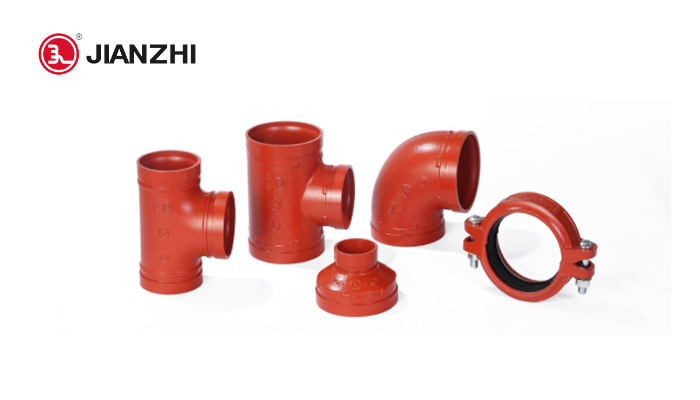
Elbows (typically 90°, 45°, 22.5°, and 11.25°) and tees are the basic building blocks for changing direction and creating branches. However, a well-designed system requires more sophisticated components.
- Reducers: Concentric and eccentric reducers are used to efficiently change the pipe size within a line. A concentric reducer maintains the centerline of the pipe, which is ideal for vertical runs. An eccentric reducer has a flat side, which is essential for horizontal runs (especially in pump suction lines) to prevent air pockets from forming at the top of the pipe. The availability of a wide range of size combinations in the catalogue can save the installer from having to fabricate complex, multi-fitting transitions.
- Crosses: An equal cross allows four pipes to meet at a single point, providing a compact solution for complex intersections that would otherwise require multiple tees.
- End Caps: A simple but vital component, the grooved cap provides a quick and reliable way to terminate a line. It is far faster and more secure than a welded cap and can be easily removed for future system expansion.
Having access to a comprehensive selection of grooved fittings allows the designer to create a more elegant, compact, and hydraulically efficient system.
The Utility of Mechanical Joint Fittings for System Expansion
What if you need to add a branch to an existing, pressurized pipeline without shutting down the entire system? This is where mechanical joint fittings, such as a mechanical tee, become invaluable. A mechanical tee clamps around the outside of the pipe. Once it is securely bolted in place, a hole is drilled into the pipe through a valve attached to the tee’s outlet. This process, known as “hot tapping,” allows a new branch line to be added to a live system, avoiding costly downtime. The availability of these specialized fittings in a catalogue demonstrates a manufacturer’s commitment to providing solutions for both new construction and system maintenance and retrofits.
Exploring Grooved Pipe Flange Adapters for Hybrid Connections
No system exists in a vacuum. A grooved piping system will inevitably need to connect to equipment, valves, or other piping systems that use flanged connections. A grooved pipe flange adapter is the perfect bridge between these two worlds. One side has a groove to connect to the pipe with a standard coupling, while the other side is a flange with a bolt pattern that matches industry standards (e.g., ANSI/ASME B16.5).
These adapters offer tremendous flexibility. They allow for the easy installation and removal of flanged components like large butterfly valves or pumps for maintenance. They eliminate the need for welding a flange onto the pipe, which is a slow, skilled, and often hazardous process, especially in a repair scenario. A catalogue that offers a full range of flange adapters in various pressure classes and standards is providing a critical tool for system integration.
Check 6: Assessing Manufacturer Support and Traceability
When you select a fitting from a grooved fittings catalogue, you are not just buying a piece of metal; you are entering into a relationship with the manufacturer. The quality of that relationship—the support, information, and accountability they provide—is a crucial, though often overlooked, aspect of the selection process. A fitting is only as reliable as the company that stands behind it. An empathetic approach to procurement involves considering the human element: who made this, and will they be there to help if something goes wrong?
The Value of Technical Data Sheets and Installation Guides
The catalogue provides the overview, but the technical data sheet (TDS) provides the details. A good manufacturer will offer a comprehensive TDS for every single product. This document should include:
- Detailed dimensional drawings with all critical measurements and tolerances.
- Material specifications for all components, including the housings, bolts/nuts, and gasket options.
- Performance data, including maximum working pressure, temperature ranges, and any relevant testing standards.
- Clear installation instructions with required torque values for the bolts.
This information is not “nice to have”; it is essential for the engineer performing stress analysis, the contractor planning the installation, and the inspector verifying compliance. Similarly, detailed installation guides and videos are a sign of a manufacturer that cares about the successful application of its products. They understand that even the best-made fitting can fail if installed incorrectly.
Tracing a Fitting Back to its Source: Lot Numbers and Quality Control
Imagine a leak occurs on a critical project. How do you determine the cause? Was it a faulty fitting, an installation error, or something else? This is where traceability becomes vital.
Reputable manufacturers emboss every fitting and coupling housing with a unique heat code or lot number. This number allows the specific part to be traced back through the entire manufacturing process. It can identify the exact batch of molten iron it came from, the day it was cast, the machine it was machined on, and the quality control reports from that production run. This level of traceability is the ultimate form of accountability. It allows for precise problem-solving and, in the rare event of a product defect, enables a targeted recall rather than a widespread panic. When you see a lot number on a fitting, you are seeing a manufacturer’s signature—a promise of quality and a commitment to standing behind their work. According to one leading manufacturer, their market return rate has remained remarkably low, a testament to their quality control (en.jianzhi-fitting.com, n.d.).
Why a Manufacturer’s Reputation and History Matter
In an industry where products are expected to last for 30, 40, or even 50 years, a manufacturer’s history is a powerful indicator of their reliability. A company that has been in business since 1982, for example, has weathered economic cycles, adapted to changing technologies, and built a long-term reputation (Jianzhi Pipe Fitting, 2023). They have a vested interest in protecting that reputation by producing high-quality products and providing excellent customer support.
A long-standing manufacturer also possesses a deep well of institutional knowledge. Their engineers have seen countless applications and solved innumerable field problems. This experience is often embedded in their product designs and their technical support. Choosing a fitting from an established, reputable manufacturer is a way of leveraging that accumulated wisdom for the benefit of your own project. It is an investment in peace of mind.
Check 7: Future-Proofing Your Selection – Sustainability and Innovation
The world of engineering and construction is not static. The standards, materials, and expectations of 2026 are different from those of 2016, and they will continue to evolve. A truly forward-thinking approach to selecting components from a grooved fittings catalogue involves not only meeting the needs of today but also anticipating the demands of tomorrow. This means considering the environmental impact of your choices and staying abreast of technological innovation.
The Rise of Lead-Free and Recycled Materials in 2026
Societal and regulatory pressure to build more sustainably is constantly growing. In the United States, the Safe Drinking Water Act has placed stringent limits on the lead content of components used in potable water systems for years. In Europe, the Registration, Evaluation, Authorisation and Restriction of Chemicals (REACH) regulation places similar controls on hazardous substances.
As of 2026, the expectation for “green” building materials is higher than ever. When reviewing a catalogue, look for manufacturers who explicitly state that their products are lead-free. Inquire about the recycled content of their ductile iron. Iron is one of the most recycled materials on earth, and a manufacturer committed to sustainability will often use a high percentage of recycled scrap in their melting process. Choosing such a product not only ensures compliance but also contributes to the circular economy and can help a project achieve certifications like LEED (Leadership in Energy and Environmental Design).
Innovations in Gasket Technology for Emerging Fluids
The fluids being transported through pipes are also changing. The transition to new, low-Global Warming Potential (GWP) refrigerants in HVAC systems, the use of novel heat transfer fluids in solar thermal applications, and the development of new water treatment chemicals all present new challenges for gasket compatibility.
A forward-looking manufacturer is actively engaged in research and development to create new gasket compounds that can handle these emerging fluids. Their grooved fittings catalogue might include options beyond the standard EPDM and Nitrile, with specialty elastomers tested for compatibility with the next generation of industrial chemicals. Partnering with a manufacturer who is at the forefront of material science innovation means your system will be ready for the fluids of the future, not just the fluids of the past. It protects the owner’s investment from premature obsolescence.
The Total Cost of Ownership: Beyond the Initial Purchase Price
Perhaps the most profound shift in procurement philosophy is the move from focusing on initial cost to considering the Total Cost of Ownership (TCO). The price listed in the grooved fittings catalogue is only one part of the equation. TCO includes:
- Installation Cost: Grooved systems are famously fast to install, reducing labor costs compared to welding or flanging (Gillard, 2017). A well-made fitting that assembles quickly and easily further enhances this advantage.
- Maintenance Cost: A reliable, leak-free joint requires virtually no maintenance over its lifespan. A low-quality fitting that requires periodic re-tightening or premature replacement incurs significant ongoing labor and material costs.
- Downtime Cost: In an industrial facility or a commercial building, a system shutdown due to a failed fitting can cost thousands or even millions of dollars in lost productivity or revenue. The premium paid for a high-quality, certified fitting from a reputable manufacturer is an insurance policy against this catastrophic cost.
- Disposal/Replacement Cost: A durable fitting that lasts the life of the building avoids the material and labor costs associated with replacement, as well as the environmental cost of disposal.
When you choose a fitting, you are making an economic decision that will have repercussions for decades. By selecting a durable, reliable, and well-supported product, you are minimizing the total cost of ownership and delivering true, long-term value to the project owner.
Frequently Asked Questions (FAQ)
What is the primary advantage of a grooved piping system over a welded system?
The primary advantage is the speed and safety of installation. A grooved joint can be assembled in a fraction of the time it takes to weld a joint, using only a simple wrench. This significantly reduces labor costs. It also eliminates the fire hazards, fumes, and need for specialized “hot work” permits associated with welding, making it a much safer option, especially in occupied or sensitive environments.
Can grooved fittings be used for potable (drinking) water systems?
Yes, but it is critical to select the correct components. The fittings must be coated with a material that is certified for potable water use, such as a lead-free, NSF/ANSI 61 compliant fusion-bonded epoxy. The gasket material must also be NSF/ANSI 61 certified. Always verify these specific certifications in the grooved fittings catalogue or technical data sheets before specifying for a drinking water application.
What is the most common cause of leaks in a newly installed grooved system?
The overwhelming majority of leaks are due to improper installation, not product failure. Common errors include: failing to properly lubricate the gasket before installation, incorrect preparation of the pipe groove, using the wrong gasket for the fluid being transported, or unevenly/improperly tightening the bolts on the coupling. Following the manufacturer’s installation instructions precisely is the key to a leak-free system.
How does a grooved system accommodate thermal expansion and contraction?
By using flexible grooved couplings. These couplings are designed to allow for a controlled amount of linear movement at each joint. As a long pipe run expands or contracts due to temperature changes, this movement is absorbed in small increments across multiple joints, preventing the buildup of dangerous stresses in the pipeline. The amount of movement each coupling can handle is specified in the grooved fittings catalogue.
Are grooved fittings suitable for use in seismically active areas?
Yes, they are highly suitable and often preferred for seismic applications. Flexible grooved couplings allow the piping system to move and deflect along with the building during an earthquake. This flexibility helps prevent the rigid pipe from fracturing, maintaining the integrity of critical systems like fire sprinklers and water lines during and after a seismic event. Specific design guidelines, such as those in NFPA 13, must be followed for these applications.
Can I connect a grooved pipe to a flanged valve?
Absolutely. This is accomplished using a grooved flange adapter. This single component has a grooved end to connect to the pipe with a standard coupling and a flanged end that bolts directly to the valve. It provides a simple, fast, and secure transition between the two connection types without any need for welding.
Why is the bolt torque specification so important?
The torque specification ensures that the correct amount of clamping force is applied to the coupling housings. Under-torquing can result in a loose joint that may leak or separate under pressure. Over-torquing can damage the bolt, the coupling housing, or the gasket, also leading to failure. Using a calibrated torque wrench to tighten the bolts to the value specified by the manufacturer is a critical step for a safe and reliable installation.
Conclusion
Navigating a modern grooved fittings catalogue is an act of professional diligence that resonates far beyond the initial act of specification. It is a process rooted in an empathetic understanding of the end-user’s need for safety, the installer’s need for efficiency, and the owner’s need for long-term value. The seven checks outlined here—from the foundational science of the materials to the forward-looking considerations of sustainability—form a coherent methodology for making choices that are not just technically sound, but also ethically responsible. The numbers and symbols in a catalogue are a language, and fluency in that language empowers the engineer, contractor, and designer to build systems that are resilient, compliant, and enduring. To select a fitting with care is to affirm a commitment to quality that protects lives, property, and the integrity of the engineering profession itself. The final structure stands as a testament not to the components themselves, but to the wisdom with which they were chosen.
References
Gillard, D. (2017). A comparison of pipe-joining methods. BSRIA.
Gong, P., Wang, S., Fu, H., Wang, J., & Liu, K. (2021). Microstructure and mechanical properties of heavy-section ductile iron with different nodularities. China Foundry, 18(6), 564–572.
Jianzhi Fitting. (n.d.). Hebei Jianzhi Casting Group-Jianzhi Casting-Jianzhi Pipe fitting. Retrieved December 10, 2026, from
Jianzhi Pipe Fitting. (2023, May 25). JIANZHI Grooved Fittings – A Leading Pipe Fitting Producer In China. Jianzhi Pipe Fittings. https://www.jianzhipipefitting.com/2023/05/25/jianzhi-grooved-fittings-a-leading-pipe-fitting-producer-in-china/
Jianzhi. (n.d.-a). About Us. Jianzhi Grooved Coupling. Retrieved December 10, 2026, from https://www.jianzhifittings.com/about-us/
Jianzhi. (n.d.-b). Grooved pipe couplings and fittings. Jianzhi Grooved Coupling. Retrieved December 10, 2026, from https://www.jianzhifittings.com/products/
National Fire Protection Association. (2022). NFPA 13: Standard for the Installation of Sprinkler Systems. NFPA.
UL Solutions. (n.d.). UL 213: Standard for Rubber Gasketed Fittings for Fire-Protection Service.